Monday, 25 February 2019

#36: Constituciones 1812-1978

Congress of Deputies, Madrid. 
Photo: Roberto GarcÍa Fadón
If you want to visit this exhibition, be warned – you will have to walk past armed police, go through a full airport-style security scan and have a copy of your passport taken first.

I guess it is partly an excuse that this is the Congreso de Diputados in Madrid – Spain’s equivalent of the House of Commons. Still, I can’t help thinking it’s a bit excessive even by the standards of Spanish bureaucracy (for example, earlier that day I had made a complaint about poor service at Atocha station, and been given four copies to take away with me).

The aim of the exhibition ‘Constituciones 1812-1978’, according to the blurb, is to ’tell the citizens about a significant part of our political and constitutional history in a simple and educational manner’.

So does it succeed in doing this? At a basic level, yes. Spain has had no less than seven constitutions, five from the 19th and two from the 20th century (the current one dates from 1978). The precious documents (and the pens used to sign them) are arranged in alcoves around the edge of the room, clockwise from the earliest, screens above each one picking out what was new – for example the 1812 constitution, which the king had to swear to, limited the power of the monarchy. The 1869 version established the right to trial by jury and freedom of worship. The 1931 constitution abolished official religion, stipulated a minimum wage and gave votes to women. The 1978 constitution… not sure – instead of information about the rights conferred we get films of committee meetings and shots of Spanish culture at the time, including Julio Iglesias with three skimpily clad blondes and a very young Placido Domingo.


I would have liked a simple infographic showing which rights were granted and which withdrawn each time – the power of the monarchy seems to wax and wane over the decades, for example. They could have taken a leaf out of The British Library’s 2015 Magna Carta exhibition, which had small screens throughout showing how almost all of the document’s provisions gradually became irrelevant, but what was important was how it has been understood and used over time.

There is little sense of what Spaniards thought of the constitutions or how the constitutions affected their lives. For me the exhibition only sprang to life at the end, with a montage of posters and leaflets about the public vote on the 1978 constitution. ‘No vote from the left for a constitution of rights!’ said one. ‘We will start to change things giving a ‘yes’ to the constitution’ said the Partido del Trabajo (workers’ party) of Spain. What was at stake? Did this constitution roll back some of the rights established in 1931, including unemployment benefit, a minimum wage (Spain currently has a very low minimum wage of about €850 a month) and the right of every Spaniard to apply for a civil service job? Or did it confirm and extend them?

There are other stories which could be told. The 1812 constitution, for example, was drafted in Cádiz under the great pressure of the Napoleonic invasion, and was the first liberal constitution in Europe. It was shared by ex-Spanish colonies like Venezuela and Colombia and is seen as heralding the breakup of the Spanish empire and as raising the status of those Latin American countries to nations of free and equal citizens. It also put the rights of Catalonians, Basques and all other Spanish people on an equal footing. And later, the removal of rights of the Catholic Church in 1831 is one of the factors blamed for the Spanish Civil War.

A series of film clips at the end added much-needed excitement and relevance to society and the wider world. So Renoir’s schoolteacher (Charles Laughton) in the 1943 film This Land Is Mine recites sentences about human rights to the boys at their desks as the Nazis come to take him away. Gregory Peck as Atticus Finch defends his falsely accused client in To Kill a Mockingbird, and turn-of-the-century factory worker Carey Mulligan gazes, enraptured, at Meryl Streep’s Emmeline Pankhurst in Suffragettes (2015). In a documentary clip, young US activist Aaron Swartz cites the first amendment and defends WikiLeaks.

But I did like my takeaway thick paper copy of the current constitution and, at a time of mistrust and contempt for politicians, admired the attempt to make politics – no, political documents – relevant. But more links with everyday life would have made it much better.

Constituciones 1812-1978 is at the Congreso de los Diputados, Carrera de San Jerónimo 36, Madrid until May 31, 2019.


Congress of Deputies picture credit: Roberto GarcÍa Fadón on Flickr


Monday, 7 January 2019

#35: Malachi Whitaker

 
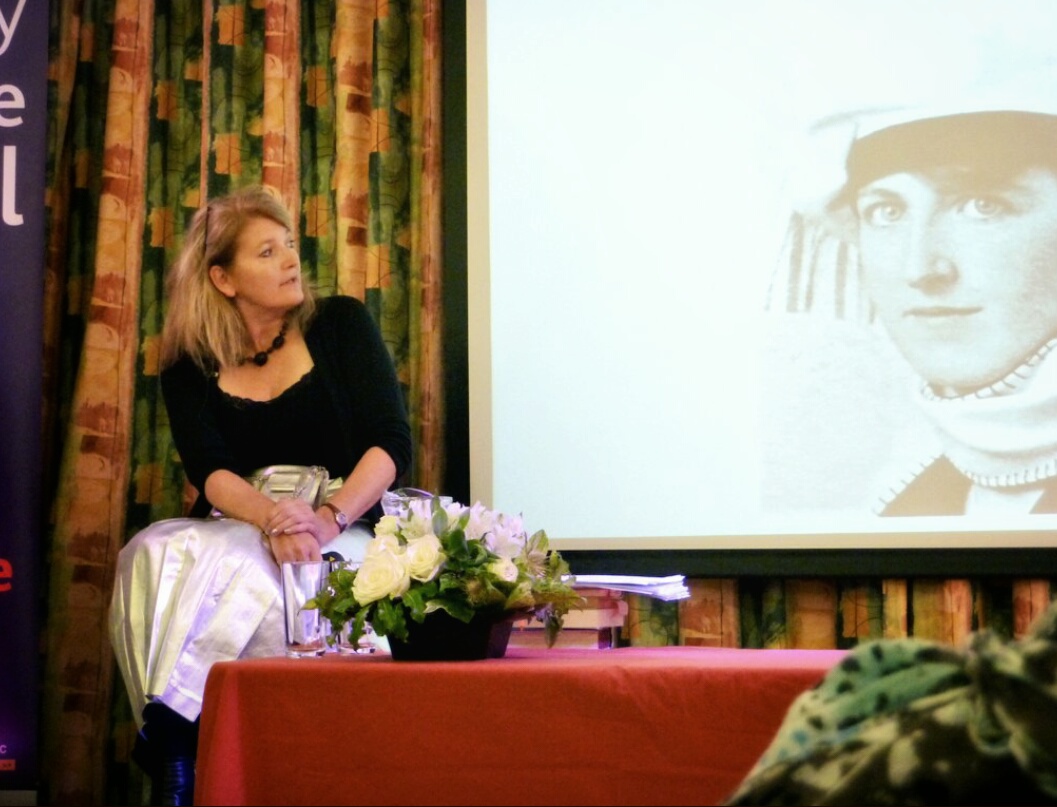
Valerie Waterhouse presenting Whitaker's 'The Journey Home and Other Stories' for Persephone Books at Ilkley Literature Festival in October 2017. Photo: Isabel Negri.

Ever heard of the writer Malachi Whitaker? No, I hadn’t either until I spoke to writer and journalist Valerie Waterhouse, who is writing a biography of this neglected author (actually a woman), as part of an ongoing rediscovery of working-class writers from the North of England. Valerie will be presenting Malachi and her work at London’s Persephone Books on 6 February, and tells us a bit more here.

Please tell us a bit about Malachi Whitaker.

Born 'Marjorie Olive Taylor' in 1895 in Bradford, West Yorkshire, Malachi Whitaker was the eighth of eleven children of a bookbinder. She attended Belle Vue Girls,  a local board school, which she left at the age of 13 to work for her father. She was largely self-taught and published her first story in 1927 at the age of 31. Between 1929 and 1939 she went on to publish four collections of short stories, a co-written spoof comic novel and a memoir, mostly with Jonathan Cape. There was a sputtering of new stories and two 'best of' selections in the 1940s -- and then: no more. She died in Skipton, West Yorkshire, in 1976, pretty much forgotten by the literary world.

You’re writing a biography of Malachi Whitaker. Why do you think her life story matters?

In October 2017, Persephone Books brought out The Journey Home and Other Stories, the first collection of  Malachi Whitaker's work for over 30 years, with a foreword by Philip Hensher and an afterword by myself.

Malachi matters because she is one of few literary authors writing about working class northern English people from eye level in the 1920s-40s, which makes her of immense social relevance. She is also a very fine writer, whose work, like that of many working class and émigré artists and writers, has been overlooked in favour of the dominant literary narrative of the time, centring around London's Bloomsbury. Working on this project, I have come to realise how dominant narratives of our literary and historic past so often prop up power structures: surely it is no coincidence that the Bloomsbury personalities were mostly upper middle class or aristocratic with their own personal sources of wealth and connections with power?

There is now a groundswell of research into alternative literary narratives -- from people of different social, ethnic, gender and sexual backgrounds -- which will hopefully provide both a foundation and historical perspective for diverse voices writing in our own age. I am not the only person researching Malachi: Susie Panesar, at Bristol University, is well into her Malachi-related PhD, and other contemporary figures are also being looked at seriously for the first time.

Can you say a bit about Northern British writers? Do you think they are relatively unknown? How might coming from Northern Britain influence their work?

Like other non-dominant groups, northern English (and Welsh and Scottish) writers do tend to get neglected, because they are not necessarily writing about subjects that fit the dominant  narrative, and because the publishing power base  is, and has always been, centred on London within the UK.

Despite this, Yorkshire, where both Malachi and I are from, has a strong literary, artistic and musical tradition producing internationally-known names during the 1920s and 1930s, including Frederick Delius, Henry Moore, Barbara Hepworth and JB Priestley, all born in the Leeds and Bradford areas. Without exception all moved away from Yorkshire to establish their reputations -- whereas Malachi lived in Yorkshire for most of her life.

In general, Northern literary work tends to display great attachment to place, mixing a challenging, sometimes hostile and occasionally beautiful industrial landscape with wild and untamed countryside. Dry, northern humour is often used to leaven seriousness, or simply to reflect the way people in the north interact -- and this is very true both of Malachi and her Hull-born contemporary, Winifred Holtby. The literary shadows of the three Bronte sisters, born in and around Bradford, hover over all northern writers, including Malachi, adding tropes such as remote moorland farmsteads and after-death haunting, to some of the work. Finally, like many northerners, Malachi has a tendency to call a spade a spade.  This directness, or bluntness, may be one reason why she couldn’t do with extraneous words, leading to her unaffected simplicity of style.

What will you be talking about at the event at Persephone Books on February 6?

After a quick whizz though Malachi’s life, I’ll be talking about connections with some of Persephone’s other northern writers: Winifred Holtby, Lettice Cooper and Marghanita Laski (born in Manchester). Malachi may not have known all of them personally, but they often wrote for the same magazines, including John O’ London’s Weekly, or reviewed each other’s work. I’ll also talk about Malachi’s London life:  she had a bolt hole opposite the British Museum and hung out with a crowd of working class-origin provincial, regional and émigré writers and artists at Charles Lahr’s Progressive Bookshop, a few minutes’ walk from Persephone Books. This provided a radical alternative to Bloomsbury.

I look forward to bringing Malachi back to her London stamping ground after an absence of seventy or eighty years!